
by GreenWorldLumber
Share
The Amazon’s Night Terror: How the Timber Cartel is destroying the Amazon Forest
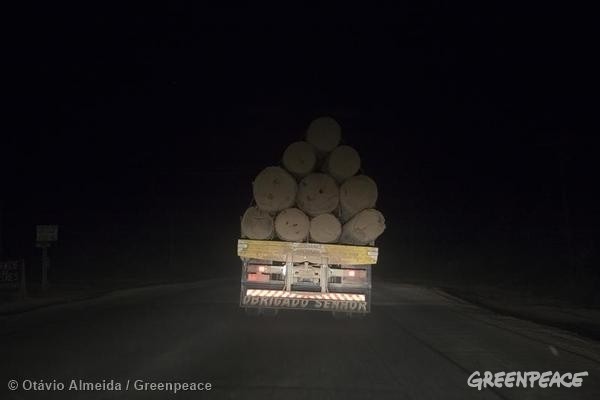
It is night time in the Brazilian state of Para, but not everything is silent. Logging trucks, taking advantage of the cover of darkness are ferrying, illegally extracted timber from the Amazon rainforest to sawmills in Santarem, Placas and Uruará, where the wood will be processed for transportation to international markets.
For the first time in its history, Greenpeace used hidden GPS locator beacons to trace logging trucks when they were transporting illegally extracted timber from the Amazon rainforests in the Brazilian state of Para, at night. Greenpeace’s investigations into the illegal lumbering and processing of timber has revealed some astonishing facts.
In the day, empty logging trucks enter the rainforest where they are loaded with timber. During the night time, they come out of these illegal timber camps and travel to sawmills, in the center of the Amazon’s logging industry, in Santarem, where they are processed. These sawmills then procure official paperwork by fraud, to launder the wood for export. The timber finds it way to countries in Europe and others like the U S, Canada, Japan and China, despite the fact that many of these countries have laws that prohibit the movement of illegally obtained timber.
How destructive logging is killing the Amazon forest
The Amazon rainforest is the world’s largest rainforest and it covers 5% of the surface area of the world. It is spread over nine countries in South America. Unfortunately, till now about 700,000 km square of the rainforest in the Brazilian part has been uprooted. The Brazilian government has taken steps to reduce the rate of loss of forest however recent studies have shown that the deforestation has begun to get worse.
The loggers have built roads deep into the forest to get to the hardwood trees. In the process, the forest becomes vulnerable to fragmentation and degradation. Subsequently, the forest on the side of these roads are cleared by settlers who use the land for farming and for rearing cattle. Moreover, these frontier lands are known for widespread corruption and poor enforcement of law. As a result, illegal logging has become endemic. For instance, just in Para state which cuts and exports more timber than any other Brazilian state, it is said that three quarters of the wood logged is illegal.
The Brazilian government finally woke up to the crisis in 2006 and came out with new laws and legislative reforms to stem the loss of forest land. These changes include electronic control systems which are supposed to track/record timber sales. Logging estates have to give the government a forest management plan every year, including a breakdown of how much timber they are going to cut. Once the forest management plans are approved, these estates get credits equal to the amount of timber they intend to harvest. All shipments and sales of timber should be accompanied by credits. It means that any timber logged outside the logging estates or if it is more than the sanctioned volume of timber, it should not get credits. Theoretically, it should be impossible to sell.
However, Greenpeace has found that loggers are exploiting weaknesses in the electronic control systems and generating additional credits. They are using these credits to launder the illegally extracted timber. For instance, loggers submit proposals to log timber from a certain area that they do not intend to log. They use the credits they get, to log timber from another place, giving it a false point of origin. When it is laundered like this, there is no way to tell illegally logged timber from legally logged ones.
Greenpeace has created a crime file around a particular company named Rainbow Trading, which controls a network of sawmills in Para. Rainbow Trading also exports the timber it processes. Using the GPS beacons, Greenpeace was able to find a connection between illegal logging in public forests and Rainbow Trading and its suppliers’ sawmills. Official reports say that Rainbow Trading acquires its timber from five privately owned sawmills but when Greenpeace analyzed satellite pictures of the estates, it found three of the five mills were not producing any timber and in the other two estates, illegal logging was occurring. The trucks that supply Rainbow Trading and its associate sawmills with timber were also found to be visiting illegal timber camps, where the logged wood could be clearly seen stacked besides the road.
It is clear that Rainbow Trading is complicit in receiving/laundering illegally obtained timber. Many of the sawmills that supply timber to Rainbow Trading do not have a license to do so, even though it is mandatory under law. The Federal government has also slapped an injunction on one of the mills which means it should stop trading timber but it is not doing so. Rainbow Trading is exporting the illegally logged timber to countries which have laws that prevent them from imported illegally felled timber. It means companies in the U S, Canada and Europe, who are buying timber from these companies are breaking the law.
It is now confirmed that the weaknesses in Brazil’s timber control system enables and even sustains the illegal logging. It is also a clear indication that it is easy to acquire fraudulent paperwork for logging in Para state.
How the investigation was conducted
The Greenpeace investigation was conducted in the municipalities of Santarem, Placas and Uruará, all of which are in Para state. Santarem is the heart of Para industry’s timber industry. In August, Greenpeace investigators placed GPS beacon locators on logging trucks operating in Santarem. Like this, Greenpeace was able to find out the mechanism used by the logging industry to bring the illegally logged timber out of the forest.
The trucks drive into the forest during the day and wait there. During this time, the timber is loaded into the trucks and then the trucks wait for the cover of night. At night, the trucks leave the forest and make their way to sawmills in Santarem, a port city and a gateway for exports.
Greenpeace traced the route taken by the trucks against official government maps. It found that the timber was being logged form public forests, which means there is no authorization for logging these trees and any logging here is illegal. Yet if you conduct reconnaissance flights over this area, you will see a number of logging camps, clearings were logged wood is stored and access roads to these camps.
The electronic control system which records the sale of timber in Mato Grosso and Para is called System for the Commercialization and Transportation of Forest Produce (SISFLORA). Greenpeace was able to obtain official documents from this system which proved that Rainbow Trading was making false claims. For instance, Rainbow Trading says that in 2014, it obtained 90 % of its timber from five logging estates.
When Greenpeace referenced the satellite imagery of the estates against the claims made by Rainbow Trading, it saw that three of the mills were not producing any timber, which means that Rainbow Trading is using the paperwork obtained by these estates for logging to legitimize illegal timber logged elsewhere.
Rainbow Trading and its suppliers have received stiff fines from IBAMA, the federal government’s environmental police in the past.
SISFLORA also has records which show that Rainbow Trading has bought timber from Saguby, Schmitt & Schnorr Ltda and Odani, which are barred from trading timber. IBAMA has suspended these companies’ environmental registration number, which means they cannot buy/sell timber. Moreover, in 2013, IBAMA obtained a legal injunction against Odani, prohibiting it from processing and selling timber.
The EU Timber Regulation says that if timber imported from another country should be called legal, it should comply with legislation(s) on harvesting timber in the country of its origin. In Brazil, companies which trade, process or export timber should have an active CTF (environmental registration number) and it is a key requirement under Brazil’s forestry laws. It is meant to ensure that the timber in the supply chain was felled, processed and traded according to the law and so it can legally exported. So timber from sawmills such as Saguby, Schmitt & Schnorr Ltda and Odani, which do not have a CTF, cannot be legally traded in Brazil and therefore cannot be exported to the EU market.
Despite the government’s efforts to keep them out of the market, the three firms continue to process timber which they later sell to exporters. Rainbow Trading has received timber from these companies, multiple times this year, which it has exported to countries such as U S, Canada, Japan, India, China and Europe. Apart from Rainbow Trading, Odani has also supplied timber to four other timber exporting companies in 2014. These companies in turn exported the timber to countries such as Denmark, China, Italy, Spain, U S, Canada, Japan, France and others. The interesting question is how have these countries ensured that the timber they imported was legitimately logged?
These issues raise several questions for government authorities responsible for enforcing laws both in and outside Brazil. The fact is, these sawmills are not only operating illegally, they are mostly handling illegal timber. Through fraud, they are obtaining official paper work to legitimize their illegal work. It is publicly known that these companies were fined in the past and have had their licenses suspended for illegal timber logging and processing. In the light of these findings, no reasonable government can conclude that companies sourcing timber through Rainbow Trading and its suppliers and placing it in their markets are in compliance with the Lacey Act or EUTR. Despite all this, timber from these companies is regularly sent to the U S, Canada and Europe.
The structural flaws in Brazil’s timber control system, the high chance of illegal logging and the fact that most of the forest management plans still have to be verified mean that official documentation on the origin of timber is not a sufficient assurance of origin or legality of the timber. Companies that are not serious about these challenges should stop buying timber from high risk areas like Para state altogether.
What can the Brazilian government do to control the illegal logging?
- Immediately investigate companies named in Greenpeace’s crime file and ensure that the illegal timber logged or processed by these companies does not enter the market.
- Immediately review all the forest management plans in the Amazon approved after 2006.
- Draw up more stringent rules for forest management plans and implement them and ensure their effective assessment and approval.
- Creation and implementation of a robust mechanism on governance, enforcement and monitoring of timber extraction in the Amazon. This mechanism should be standardized for the rest of the country and should be transparent.
- All sawmill licenses should be reviewed and a new regulatory system should be created under which they shall operate.
- The capacity of federal and state environmental agencies should be increased by building additional infrastructure and increasing funds for surveillance, enforcement and monitoring. Penalties should be imposed on those who are convicted for forest crimes.
What can companies do?
- Companies should stop purchasing timber logged in the Amazons unless their partners can furnish credible proof and assurance that the timber was logged legally. It will include complying with relevant customs and trade legislation. They should also ask for proof apart from current official documents that the exporter has not been a party to forest degradation, deforestation, social impacts (negative) and biodiversity loss.
- Brazilian timber should be immediately classified as high risk, given the problems in management, enforcement and monitoring of laws in Brazil.
- Companies should put in place strong policies on procurement, ensuring that the timber is purchased legally and was not responsible for forest degradation, deforestation, social impacts (negative) or biodiversity loss.
What can government agencies in the importing countries do?
- Conduct investigations against companies identified by Greenpeace and find out if they have taken any steps to mitigate risks about placing illegally procured timber in the market and to enforce action against companies who have failed to follow the legislation on the subject.
- Any company that is not able to show that it undertook due diligence before procuring timber from the Brazilian Amazon, under EUTR or has failed to undertake measures to mitigate risks, should be penalized.
Reference